


The Rainey Report is how Troy Knight and Andrea Corrales share what we know about Seattle real estate: honest market data and what’s getting built near you, delivered straight.
From the September 8, 2026 edition. Get the next one in your inbox.
Keys to the Market
The Number Every Seattle Landlord Had to Learn This Year
Washington’s new rent law sets a hard cap on rent increases for the first time in state history.
But the exemption inside it has an expiration date most buyers don’t know to look for.
A client of mine was three weeks from closing on a triplex in the Central District when her lender’s underwriter called with one question: when was the certificate of occupancy issued? Not the roof. Not the foundation. The paperwork.
She didn’t know off the top of her head, and honestly, neither did I at first. It mattered because the building went up in 2011, which puts it well outside the one exemption in Washington’s new rent law that actually moves the needle for an investor.
Washington’s rent stabilization law, House Bill 1217, took effect last year and set a hard ceiling on rent increases for the first time in state history. For 2026, that ceiling sits at 9.683% over any 12-month stretch, calculated as 7% plus inflation, or 10%, whichever lands lower.
A landlord can’t raise rent at all during a tenant’s first 12 months in a unit, and once that window closes, any increase has to clear two separate notice requirements before it can take effect: Washington’s own floor of 90 days, and Seattle’s stricter rule of 180 days, which is the one that actually governs inside city limits. The cap itself only applies to tenants already living in the unit. Once someone moves out, the next lease can be priced at whatever the market will bear.
There’s one exemption that actually changes the math for an investor, and it’s tied to age, not luxury or owner-occupancy. A building’s certificate of occupancy must be dated within the last 12 years, and that clock doesn’t freeze at a fixed calendar year. It’s measured back from whenever the rent increase notice actually goes out, which means the window is always sliding forward. A building that’s exempt today has an expiration date built into it, whether anyone thinks to check for it or not.
That’s the point worth sitting with for my client’s triplex. It isn’t just outside the window today. It can never get back inside it. That’s already true for any building older than 12 years, and it’s coming for every building that’s currently exempt, too.
A 1920s Craftsman fourplex and a 2016 townhome-style triplex might list for the same price and rent for similar amounts today, but they aren’t the same investment. One has been fully subject to the cap for years. The other is exempt only until 2028, when it turns 12 and is subject to the same rules.
Our Take
Don’t treat the new-construction exemption as permanent, because it isn’t. If a client buys a 2016 building today partly because it’s exempt from the rent cap, I mark 2028 on the calendar with them: that’s when the exemption expires for good, whether they’ve sold by then or not. The certificate-of-occupancy date matters twice, once at purchase, to know if you’re getting the exemption at all, and again years later, when you need to know exactly how much runway is left on it. I’d rather a client buy an older building and underwrite it as capped income from day one than buy new construction assuming the exemption lasts forever.
Shaping Seattle
The Station That Turned a Freeway Median Into the Central District’s Front Door
Judkins Park’s light rail stop finally opened after a decade of delay.
Rainier Avenue South already looks like developers didn’t wait around for it.
Drive down Rainier Avenue South between South Massachusetts Street and South Holgate Street these days and you’ll notice more construction cranes than you would have five years back, which is easy to miss if you’re not paying attention to what a single transit stop can do to the land around it.
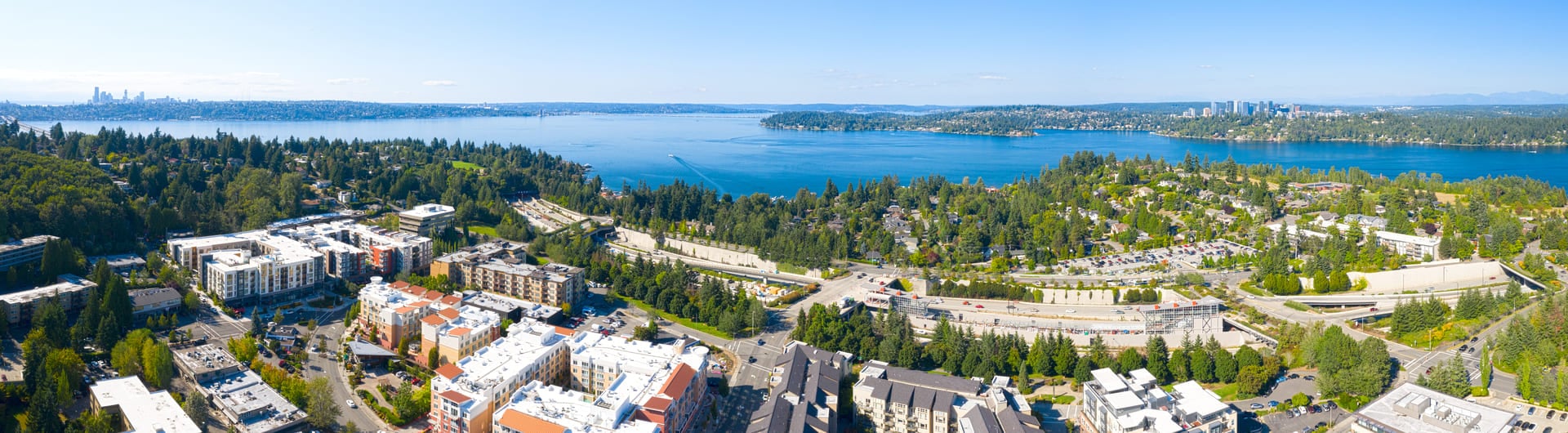
Judkins Park Station opened on March 28 this year, nearly three years behind its original schedule, as part of the 2 Line’s Crosslake Extension connecting the Central District to Mercer Island, Bellevue, and Redmond. It runs on the world’s first light rail line to cross a floating bridge, over I-90’s span across Lake Washington.
Getting the neighborhood ready meant more than just the platform. Rainier Avenue South picked up a new northbound bus lane, fresh signals at South Grand and South College streets, and repainted crossings over the I-90 on and off ramps. The city’s own transportation plan flags Rainier as a “stroad,” department shorthand for a street that’s stuck trying to do a highway’s job and a neighborhood’s job at the same time, and lists safety upgrades there as a top priority that’s still years from finished.
The apartment buildings didn’t wait for any of that to catch up. Multiple new buildings have already gone up along that stretch between Massachusetts and Holgate, filling in a corridor that spent decades better known for traffic than for foot traffic.
The Apartment Building That Grew Up Around Three Bars Instead of Bulldozing Them
Capitol Hill’s development slowdown has been real, but the Tanager Apartments prove infill and legacy nightlife can still share a block.
Ask anyone who’s spent a weekend on Capitol Hill in the last decade what they expect to happen to their favorite dive bar once new construction shows up next door, and the answer is rarely optimistic. The seven-story Tanager Apartments opened this spring at 14th Avenue and East Madison Street, built to rise around Chop Suey, the Madison Pub, and Diesel instead of over them, and all three bars stayed open through the entire construction process.
It’s a mixed-use building, meaning it stacks apartments above ground-floor commercial space instead of choosing one or the other, and it’s one of the few new buildings to rise on the Hill during an ongoing citywide construction slowdown driven by high costs and higher interest rates. A few blocks over, permits recently filed for the long-vacant office buildings along East Olive Way cover only demolition so far, which some read as a hopeful sign and others read as just another empty lot waiting on better timing.
The CID’s Newest Affordable Housing Project Wants Its Ground-Floor Tenants to Own, Not Rent
A nonprofit developer in the CID is trying something Seattle hasn’t really done before: letting the corner store own its own corner.
Walk through Canton Alley South on a weekday afternoon and you might pass a mahjong game, a mobile book fair, or a construction fence marking the future site of one of the neighborhood’s next affordable housing projects. The Seattle Chinatown International District Preservation and Development Authority, a nonprofit known as SCIDpda, acquired the site at 615 8th Avenue South in March, and in June the Seattle Foundation put $500,000 toward predevelopment work on the project, known as 8th and Lane.
The building will stack family-sized affordable apartments above ground-floor retail, the same formula behind most of SCIDpda’s earlier projects. What’s different this time: SCIDpda is exploring letting a business buy its ground-floor commercial space outright, condo-style, instead of only ever leasing it, a first for the organization.
Our Take
Seattle’s growth this year isn’t showing up as the sweeping rezone maps buried in the One Seattle Plan headlines. It’s showing up as small, specific moves: a rail platform slotted into a freeway median, a building that grew around its neighbors instead of over them, a nonprofit testing out what happens when a small business owns its own storefront instead of renting it. None of these will change the skyline. All three will move property values on their blocks faster than any citywide zoning map, and faster than most buyers are watching for right now.
What would your house sell for right now?
Not a Zestimate. Tell us about your place and we’ll send back a real number from people who know your neighborhood.
Troy Knight
Andrea Corrales
Global Real Estate Advisors · Rainey Property Group | Skyline Properties
Want The Rainey Report in your inbox? Subscribe here.